
Climate Change and Energy Transition
Gunvor’s journey towards environmental responsibility
At Gunvor, our commitment to sustainability and ethical business practices is fundamental. We believe that transparency is the cornerstone of sustainable development and investor confidence. By adhering to the EU Taxonomy Regulation’s disclosure requirements, we aim to provide a clear and robust framework for our stakeholders to assess the sustainability and environmental impact of our operations.
Our sustainability report goes beyond compliance, offering insights into our strategic approach, the challenges we face, and the progress we are making towards our environmental objectives. It underscores our ongoing efforts to innovate, invest in sustainable practices, and contribute to the global sustainability agenda. To enhance our commitment to these core principles, we acknowledge the importance of disclosing the segments of our turnover, capital expenditure (Capex), and operational expenditure (Opex) that are attributed to environmentally sustainable initiatives and intend to incorporate these figures in the forthcoming versions of our sustainability report.
As we progress on our sustainability journey, Gunvor not only complies with current regulations but is also actively preparing for future standards. We are closely monitoring the development of the European Union’s Corporate Sustainability Reporting Directive (CSRD), which aims to improve the scope, quality, and comparability of sustainability reporting. Our team is diligently assessing the impacts of these forthcoming requirements on our reporting processes and sustainability strategies. We are investing in the development of our data collection and analysis capabilities, enhancing our reporting systems, and engaging with our stakeholders to ensure transparency and inclusivity in our sustainability communications.
Climate Change
Transition plan for climate change
In adherence to the CSRD, Gunvor is actively shaping its climate transition plan, aimed at achieving net-zero emissions by 2050. Our transition plan will include a comprehensive adaptation of our assets, operations, and business models to ensure a sustainable, low-carbon future.
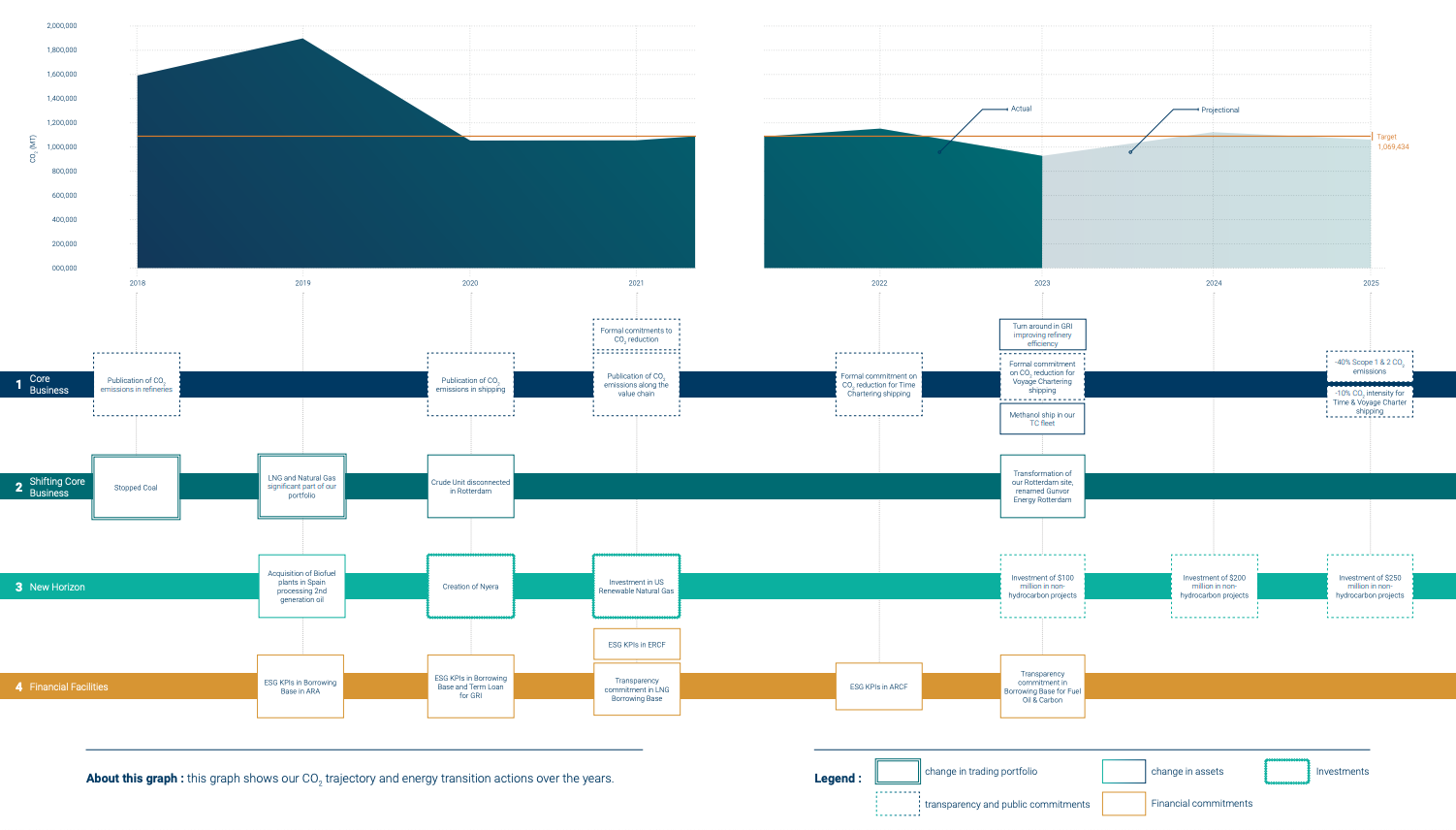
We are currently dedicated to decreasing our carbon footprint, with a specific target to reduce our Scope 1 and Scope 2 greenhouse gas emissions by 40% by 2025, while also strategizing to lower our Scope 3 emissions, encompassing indirect emissions across our value chain.
Simultaneously, Gunvor is navigating the evolving environmental and market landscapes by diversifying our portfolio to include more sustainable commodities and businesses. Presently, 31% of our trading portfolio comprises “transitional” commodities, aligning with the EU Taxonomy, and includes products such as biofuels, natural gas, and liquefied natural gas (LNG). In accordance with our sustainability trajectory, we have exited physical coal trading in 2018 and have invested in biofuels production facilities.

NYERA
Since its inception, Nyera—Gunvor’s dedicated vehicle for Energy Transition investments—has undertaken and supported numerous projects to help advance the global goal of net-zero emissions. In doing so, given Gunvor’s imperative to operate on a commercial basis, Nyera has remained deliberate and prudent in its approach, with a focus on long-term, sustainable businesses. Areas of interest for Nyera are diverse, ranging from more traditional renewables opportunities to entirely exploratory ventures.
For example, the company looks extensively at the deployment of capital in renewable power, such as solar, wind and biomass. This would be in terms of both offtakes and investments. Nyera is also exploring opportunities in the alternative fuels space, in particular with ammonia and hydrogen, to support the commercialization of these fuels as part of the global energy mix. Blue and green hydrogen, specifically, have the potential to be commoditized, which works well with the company’s overall business model.
Nyera has also been working towards investments in existing, legacy infrastructure, both in terms of energy efficiency and emissions reductions initiatives. These efforts particularly impact Gunvor’s refinery operations in Rotterdam and Ingolstadt, where preparations continued in 2023 for major projects to be underway.
Consistent with Gunvor’s overall corporate strategy, investments serve to complement the company’s core trading activities, which in many cases are supporting the further development of Gunvor’s Power desk, which is located in London, where Nyera as an organization is seated.
Due to commercial sensitivities and the highly competitive nature of the Energy Transition space, not all projects have been announced. However, examples of projects undertaken throughout the year include:
Green Hydrogen Production in California: Gunvor USA LLC, a subsidiary of Gunvor Group, is advancing its energy transition strategy by signing a Letter of Intent with Yosemite Clean Energy LLC, a Californian company specializing in converting biomass to green hydrogen. This agreement focuses on the acquisition and marketing of green hydrogen produced at Yosemite’s first three facilities in Oroville, Tuolumne, and Visalia, California. These sites will collectively produce green hydrogen using biomass from forest management and post-wildfire recovery, supporting wildfire prevention and agricultural waste management. The Oroville plant is set to start in late 2025, with the others following in the next two years.
Hydrogen Import Terminal: Gunvor Energy Rotterdam and Air Products (NYSE: APD) signed a joint development agreement for an import terminal in Rotterdam. The agreement responds to the accelerating demand for green energy sources to meet net-zero emissions climate objectives and the need to diversify energy sources. The import terminal is expected to provide green hydrogen to the Netherlands starting in 2026.
Plastics Recycling: At Gunvor Energy Rotterdam, collaboration with Dow, a U.S.-based material science company, continued to focus on refining plastic waste streams to enhance circular plastic production. Gunvor provides Dow in Europe with a refined feedstock from plastic waste, aimed at manufacturing circular plastics. This refining process ensures that the pyrolysis oil feedstocks meet the quality standards required for creating new polymers.
Sustainable Aviation Fuel Manufacturing: Gunvor Group is collaborating with VARO Energy to establish a substantial Sustainable Aviation Fuel (SAF) production facility at the Gunvor Energy Rotterdam site. The facility is designed to produce 350,000 metric tons per annum, with around 70% dedicated to SAF and the rest to bio-naphtha and bio-propane. The VARO facility will feature flexible production capabilities, ranging from 100% SAF to 100% HVO, along with advanced pretreatment technologies, positioning it as a leader in the SAF sector. Strategically located at the center of Europe’s energy hub, the GER site’s existing infrastructure will facilitate swift development, with production anticipated to start by the fourth quarter of 2026.
ENERGY EFFICIENCY INITIATIVES AT GUNVOR REFINERY INGOLSTADT (GRI)
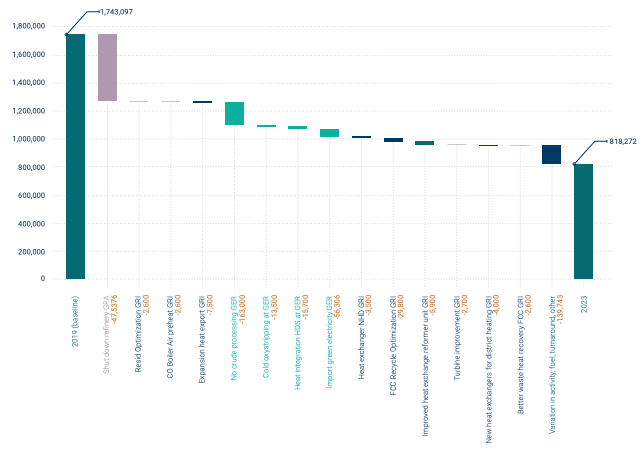
The Gunvor Refinery in Ingolstadt, known for its high energy efficiency by European standards, has further reduced its energy usage recently. The long-term targets set as part of the energy management system, certified in accordance with ISO 50001, to reduce specific energy consumption were achieved in 2022. Energy projects have also been implemented in Turn Around 2023 (TA23) as part of this continuous improvement process.
New Heat Exchangers for Waste Heat Supply
Gunvor Refinery operates a steam turbine plant with three generators for its own electricity production. The impeller of one of these steam turbines was replaced during an overhaul. This made it possible to increase the efficiency of the entire system. Reducing demand for fuel gas saves energy, meanwhile the power generation of the system remains the same.
Impeller Exchange at Turbine for Electric Generator
The waste heat utilization was improved with the installation of new heat exchangers. The Gunvor Refinery and its business partner Stadtwerke decided to implement a new heat exchanger technology. Four existing twisted tubes were replaced with plate heat exchangers. This means that the waste heat potential is better utilized, and significantly more waste heat can be made available to the municipal utilities and the refinery.
Heat Exchanger Rebundle at Naphtha Reformer Unit
A pinch analysis showed an energy inefficiency in the naphtha reformer area. These inefficiencies were eliminated by a rebundling of heat exchangers. For this purpose, existing heat exchangers were taken out of service and five new exchangers were installed on optimized process positions. This means that waste heat generated in the Reformer process area can be better utilized and the need for steam can be reduced. This leads to a reduction in the refinery’s overall steam production demand.
Gunvor energy Rotterdam (GER) 2023 projects and 2026 outlook
Gunvor Energy Rotterdam (GER) is set to implement a significant energy and CO 2 reduction initiative during the Turn Around 2026 (TA26). In 2023, the facility successfully completed two energy-saving projects: periodic cleaning of the Light Ends units and reduction/elimination of natural gas usage in burner headers.
Clearlake shipping’s sustainability strategy in maritime operations
Clearlake Shipping, a Gunvor Group subsidiary and one of the world’s leading tanker vessel charterers, is at the forefront of integrating sustainable practices in maritime operations. The launch of “Project ECO” covers both hardware improvements and software developments designed to promote Efficient Commercial Operations and Energy Efficiency Design Features.
At sea, our focus is on fuel efficiency and optimizing vessel operations. We have adopted slow-steaming practices and integrated dual-fuel vessels that utilize lower-carbon fuels such as LNG, significantly reducing our emissions. Our strategic voyage planning uses Blue Water Optimum Speed Services (BOSS) weather routing technology, enabling our fleet to select the most optimum maritime routes, coupled with virtual arrival techniques to minimize idling times near ports. These initiatives align with our strict adherence to regulatory standards, including the IMO 2020 sulfur cap and greenhouse gas emissions regulations, and our commitment to the Energy Efficiency Design Index (EEDI), ensuring our new ships meet or exceed these environmental benchmarks.
Our hardware strategies are equally robust, featuring sustainable technologies like exhaust gas cleaning systems to reduce sulfur emissions and ballast water treatment systems to protect marine biodiversity. Maintenance routines are meticulously planned, involving regular hull cleanings and the use of ecofriendly antifouling paints, thus enhancing our ships’ operational efficiency and environmental compatibility.
We are also pioneering in Energy Efficiency eXisting ship Index (EEXI) improvements through innovative applications like silicon-coated propellers and the installation of energy-efficient technologies onboard. The exploration of alternative fuels is pivotal, with our fleet incorporating Liquefied Natural Gas (LNG), methanol, Liquefied Petroleum Gas (LPG), and bio-diesel options, reflecting our proactive stance in transitioning to greener energy sources.
In our pipeline, we are exploring onboard energy consumption reductions, such as transitioning to LED lighting and harnessing waste heat recovery systems. The LNG vessels we are commissioning are designed to be exceptionally efficient, featuring ME-GA engines that not only excel in performance but also significantly reduce methane emissions, further supplemented by state-of-the-art air lubrication and sub-cooler technologies.
In-port performance monitoring and analysis
In the shipping sector, a solution was introduced to optimize port operations, offering numerous benefits:
Material impacts, risks and opportunities and their interaction with strategy and business model
Since 2018, Gunvor has been actively addressing climate-related risks, implementing various actions, projects, and commitments to lessen the impact use of its operations.
Our Risk Management process recognizes climate change primarily in two areas: the “physical risk” including impact on shipping activities and terminals on lower grounds, and the “business risk” as the industry shifts towards more sustainable energy sources. In 2023, an overall risk assessment for the entire company took place, allowing us to review our assessment of the business risk of climate change as well as its physical risks.
Furthermore, in compliance with the Corporate Sustainability Reporting Directive (CSRD) guidelines, we will be carrying out a formal Double Materiality Assessment (DMA) which will be the object of a full description in the next iteration of this report. This process entails evaluating our impact on environmental and social aspects and understanding how these impacts, in turn, affect our business.
Targets related to climate change mitigation and adaptation
2023 performance overview
| Objectives | 2019 | 2020 | 2021 | 2022 | 2023 | Target | Status | |
|---|---|---|---|---|---|---|---|---|
| Direct Emissions – Score 1 (tCO2) | 1,674,450 | 1,003,299 | 946,810 | 1,031,414 | 934,761 | 40% vs 2019 by 2025 | Amber | |
| Indirect Emissions – Score 2 (tCO2) | 107,939 | 33,637 | 77,834 | 9,270 | 4,515 | -40% vs 2019 by 2025 | Amber | |
| Fleet Composition – % Eco-vessels | Co-owned | 72% | 100% | 100% | Green | |||
| Time Chartered | 60% | 66% | 50% | 52% | 75% | |||
2024 Objectives
Gross scopes 1,2,3, and total ghg emissions
The trading, transport and refining of crude oil, petroleum products and other commodities are associated with significant greenhouse gas emissions. At this stage, greenhouse gas reporting is limited to the carbon dioxide (CO2 ) and methane (CH4 ) (currently limited to the refining sites). Inclusion of nitrous oxide (NO2 ) and other greenhouse gases will be evaluated in the future.
This year, our Scope 1, 2, and 3 (shipping) emissions have been verified by a third party. The scope of this verification will widen in time.
The emission data shared in this report is the following:
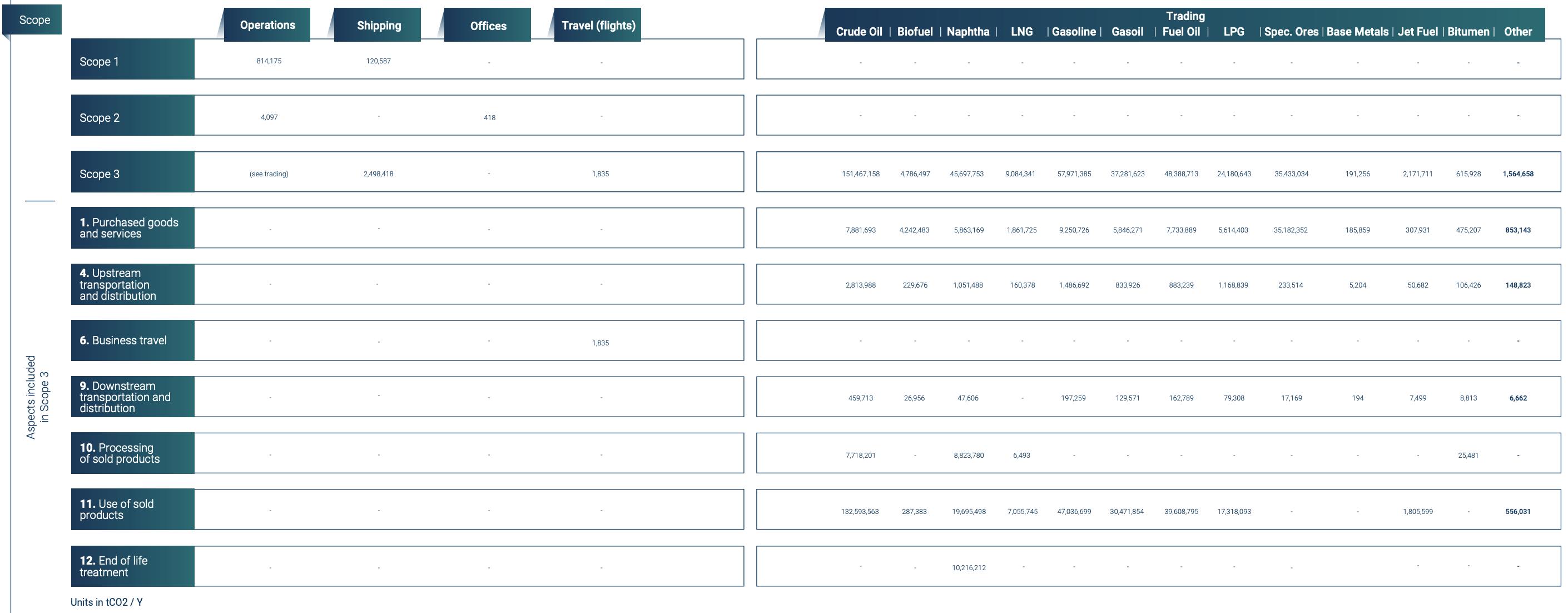
The full inventory of CO2 emissions along our supply chain is a complex endeavour and Gunvor works at improving the quality of the data shared year on year. This year, the calculation of Scope 3 emissions related to traded products has significantly broadened. While in 2022, we only accounted for emissions from four products (crude oil, biofuel, naphtha, LNG), in 2023, we included additional 8 products, such as gasoline, gasoil, jet fuel, metals and others. This expansion accounts for the rise in our Scope 3 emissions compared to last year. Looking at the whole Scope 3, the weighted average intensity of our traded book is 3.5 tCO2 /ton.
The table details our CO2 emissions for 2023, specifying the Scope 3 subcategories considered in line with the Greenhouse Gas Protocol Technical Guidance. Further details on the total volume of Scope 3 emissions from traded products and other pertinent information are available in a separate section of this report. Additional information regarding our Scope 1 and 2 emissions for our operational sites and shipping activities will also follow in subsequent sections.
Click for high resolution version
Click for high resolution version
CO2 emissions in refineries (scope 1 & 2)
The following graph depicts the direct CO2 emissions from Gunvor refineries (Scope 1) and the indirect CO2 emissions from purchased electricity (Scope 2). The emissions declined sharply in 2020 due to reduced refining activity. In the following years a further reduction was achieved by several measures. We reduced the Scope 2 emissions by changing our electricity purchase contracts in order to only purchase green or nuclear electricity in our Rotterdam and Ingolstadt sites. Gunvor’s commitment is to reduce the Group’s Scope 1 and 2 emissions by 40%. This reduction commitment against baseline 2019 is to be achieved in 2025.
For the refining activities, this reduction is within reach and the company will be working to further improve the climate impact and define reduction trajectories towards 2030. The two largest CO2 emitters are the Ingolstadt refinery (GRI) and the Rotterdam site (GER). In Ingolstadt, Gunvor focuses on technological improvement projects, some of which were implemented during a major turnaround in 2023. In Rotterdam the focus is on energy transition projects with third parties.
CO2 emissions (t/year) Gunvor Refining (Scope 1&2)
Click for high resolution version
CO2 emissions in shipping (scope 1 & 3)
The composition of our fleet provides visibility on the intrinsic efficiency of our shipping activities, to which we add operational optimization. Our Time Chartering fleet composition has improved, and we still need to progress to reach our 75% target. By December 2023, all our co-owned fleet was 100% Eco-vessels. Additional vessels will be added as we are involved in the construction of new Liquefied Natural Gas (LNG) and Liquefied Petroleum Gas (LPG) carriers, until other lower-carbon fuel solutions are commercially viable. The company remains committed to improving its Scope 3 emissions footprint and to increasing the share of Eco-vessels in its portfolio.
In 2023, the company company has outlined specific targets to lower carbon intensity in its Time Chartering fleet by 5% from the 2021 baseline to demonstrate its commitment to reducing Scope 3 emissions. This target has not been met due to persistent disruptions in the global shipping market caused by the unexpected events in 2022, which hindered efforts to revert to 2021 baseline levels. Despite these challenges, Gunvor managed to decrease the carbon intensity of its fleet by 4% in 2023 compared with 2022 through various optimization strategies, such as adjusting routes, speeds, and fuel types. This reduction aligns with the year-over-year targets set by the Sea Cargo Charter. In fact, to improve its emission performance in operations and reduce the carbon intensity of each ship, Clearlake optimizes each voyage through its dedicated program ECO. It allows to optimize emissions
for a given passage, and the performance-monitoring dashboards highlight underperforming vessels. Performance monitoring dashboards analyze, track, and compare multiple vessels’ performance and emission efficiency. Fuel savings, and therefore emissions avoidance, are calculated on the basis of the difference between the actual consumption of the vessel in the Main Engine, travelling as per the optimized plan and benchmark consumption, i.e., if the vessel was to proceed at the ordered speed on a standard navigational route/ intended route of the vessel throughout the passage.
A total of 885 legs were optimized, respecting Target Estimated Time of Arrival (ETA), Laydays Commence and Cancelling date (Laycan), Charter-Party (CP) Speed compliance, etc.
In 2023, a saving of 3,821 metric tons (MT) of fuel translated into a total carbon emission reduction of 11,890.45 MT, equivalent to nearly 10% of Gunvor’s Scope 1 emissions for shipping, as well as reduction in other air emissions. Going forward, Clearlake has deployed systematic hull cleaning and propellor polishing during maintenance and test a Liquefied Natural Gas (LNG) voyage optimization system, which aims to limit boil-off rates by optimizing tank pressure and maximizing the utilization of generated natural boil-off gas (NBOG). The system employs a hybrid approach based on machine learning and thermodynamic principles to optimally plan and monitor LNG legs with efficient boil-off-gas management, speed scheduling, and weather routing.
CO2 emissions related to traded products (scope 3)
A large portion of the products that Gunvor trades is fuels. They contain carbon, which is released as CO 2 when the fuel burns. Some products release more carbon per unit of energy than others and it is Gunvor’s aim to reduce the CO 2 intensity of the company’s traded products. To that end, Gunvor has committed not to trade physical coal and is investing in renewables. Gunvor’s portfolio has evolved over the past years, towards commodities seen as participating in the energy transition in the European Taxonomy: natural gas, Liquefied Natural Gas (LNG), Biofuel, Liquefied Petroleum Gas (LPG), etc. In 2023, the total volume traded rose by 8% year-on-year, reaching 177 million metric tons, up from 165 million metric tons in 2022. The volumes of Natural Gas and LNG declined by 15% in the previous year. Despite this decrease, Gunvor’s commitment to grow its Natural Gas and LNG trading to levels seen before the crisis remains firm.
According to the International Energy Agency (IEA), the global demand for liquid and gaseous fossil fuel is still increasing and will be a major part of the energy mix for many years to come. Gunvor is focusing on understanding the CO 2 intensity in the supply chain of products it trades, including during exploration, transportation, production or refining, and end use. With the help of partners such as CarbonChain, Gunvor is analyzing these emissions on several trades and several products. This increases our insight on where we can influence emissions.
The part of the value chain upon which Gunvor has the most influence is transportation, the initial focus of the company’s reduction efforts.
GHG removals and ghg mitigation projects financed through carbon credits
Gunvor’s focus on nature-based solutions
Nature-based Solutions (NbS), emphasizing the protection, restoration, and sustainable management of ecosystems worldwide, play a pivotal role in addressing the underlying causes and impacts of climate change. Studies indicate that such approaches could contribute about 30% of the affordable mitigation required by 2030 to keep temperature increases under 2°C.
These solutions also provide crucial protection for communities vulnerable to climate change and offer multiple societal advantages.
Aligned with this international movement, Gunvor is integrating NbS into its wider climate strategy, which encompasses purchasing carbon credits from initiatives aimed at ecological preservation and restoration.